Memory
Priya asks your support agent a follow-up question halfway through a chat, and the agent answers as if it had been paying attention the whole time, because it had. Two days later she messages again on WhatsApp and the agent still remembers that she prefers morning appointments. That continuity is built into every AI Agent.
Memory isn't a separate card you attach. It's on by default for every agent, and you tune it in the Memory section of the AI Agent node itself. This page explains what each setting does and when you might switch one off.
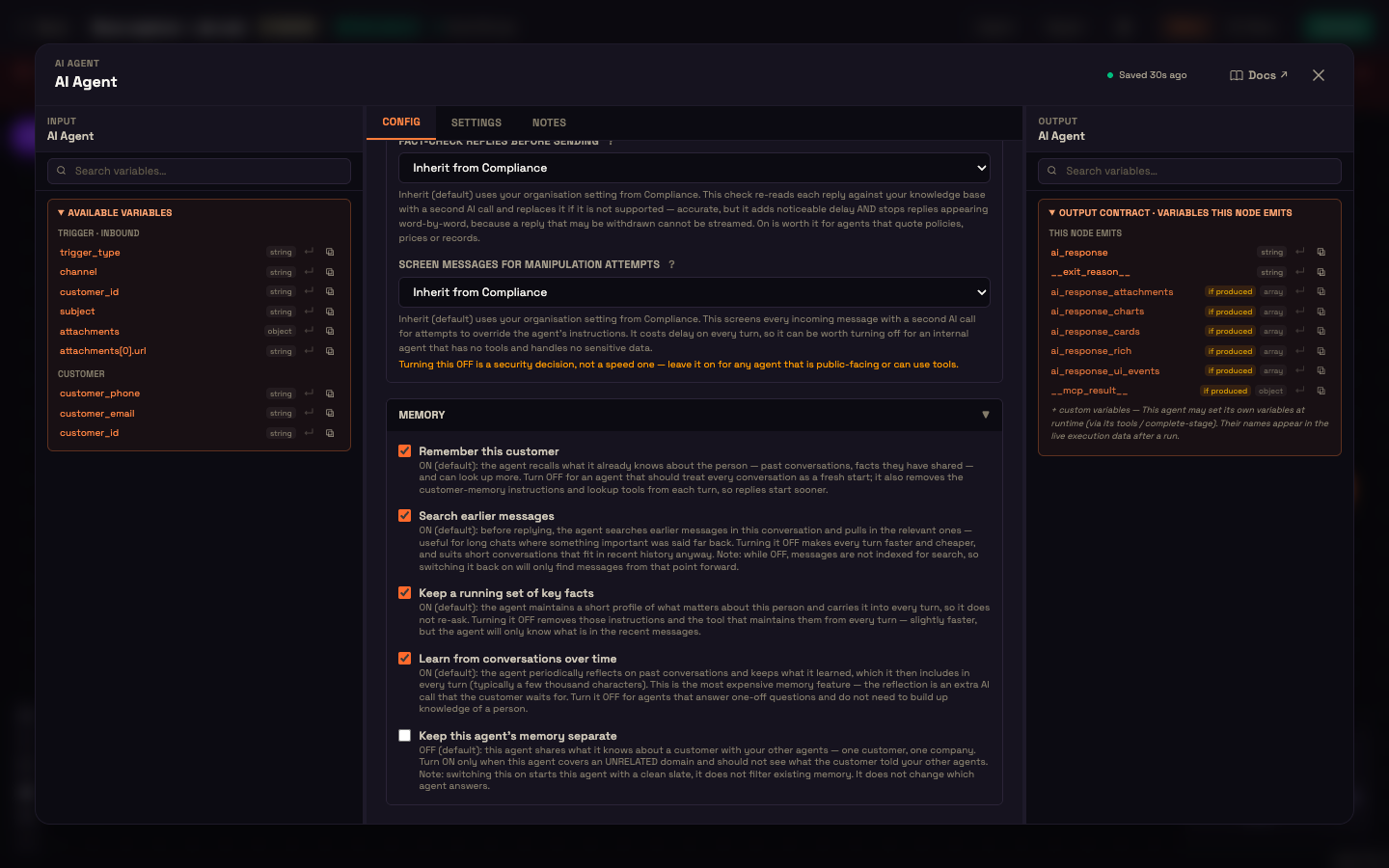
Where to find it
Open Build → Agents → your agent, click the AI Agent card, and scroll to the Memory section of the Config tab. It sits below Safety.
The five settings
| Setting | Default | What it does |
|---|---|---|
| Remember this customer | On | The agent recalls what it already knows about the person, such as past conversations and facts they've shared. Turn it off for an agent that should treat every conversation as a fresh start. Replies then start slightly sooner. |
| Search earlier messages | On | Before replying, the agent searches earlier messages in the conversation and pulls in the relevant ones. This helps in long chats where something important was said far back. |
| Keep a running set of key facts | On | The agent keeps a short profile of what matters about this person (name, preferences, what they're trying to do) and carries it into every turn, so it doesn't ask again. |
| Learn from conversations over time | On | The agent periodically reflects on past conversations and keeps what it learned, which it then includes in every turn. |
| Keep this agent's memory separate | Off | By default all your agents share what they know about a customer: one customer, one company. Turn this on only for an agent that covers an unrelated area and shouldn't see what the customer told your other agents. |
The panel's own help text under each setting explains the trade-off in the same terms.
Choosing what to turn off
Every memory feature adds a little work to each turn. For most agents the defaults are right. These are the common reasons to change them:
- One-off question answering (an FAQ bot, a product lookup): turn off Learn from conversations over time. It's the most expensive memory feature, because the reflection is an extra AI call, and a one-off agent has nothing to build up.
- Short conversations that always fit in recent history: turning off Search earlier messages makes every turn faster and cheaper. While it's off, new messages aren't indexed for search, so switching it back on only finds messages from that point forward.
- An agent that must not carry context between visits (a kiosk, a shared device): turn off Remember this customer.
- A separate line of business that shares a customer base with your other agents but shouldn't read their conversations: turn on Keep this agent's memory separate. The agent then starts with a clean slate. This doesn't filter or delete existing memory, and it doesn't change which agent answers.
What's always on
One kind of continuity isn't a setting at all:
- Recent conversation history. The agent always sees the most recent turns of the current conversation, trimmed to fit its working budget. Earlier parts of a long chat are reached through Search earlier messages.
Where your business data lives
Memory is about the conversation and the person: what they said, what they prefer, what they're trying to do. Facts that belong to your business, such as order status, lab results, balances or bookings, should come from your own systems when the agent needs them, through an Integration or an Action. That way the agent always reads the current value instead of a remembered copy that may be out of date.
| Question | Where the answer comes from |
|---|---|
| "What did I say two messages ago?" | Recent conversation history (always on) |
| "You know I prefer mornings." | Keep a running set of key facts / Remember this customer |
| "What does your returns policy say?" | Knowledge |
| "What's the status of my order?" | Your system, through an Integration or an Action |
See also
- AI Agent Node: the node that holds the Memory section.
- Knowledge: answering from your documents.
- Integration: reading live data from your own systems.